-
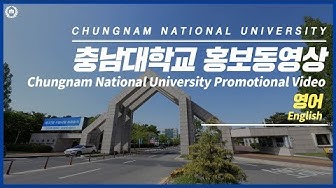 03:12
03:12
충남대학교 홍보동영상(영어)
‘Jump CNU!’ An Innovative University Leading the Frontier of the 4th Industrial Revolution Chungnam National University (CNU), founded in 1952, has been cultivating the best minds in Korea under the educational motto of ‘Creativity, Development, and Service to the Community.’ Through the university's prominent faculties with active research and educational capabilities, in addition to academic-industrial cooperation, CNU has been performing a key role as the most prestigious national university in the central region of Korea. (1) KNU10, leading national universities created by local demand and enthusiasm CNU is one of KNU10 (Korea National University 10) which is comprised of ten leading national universities including Chungnam National University, Seoul National University, Gangwon National University, Gyeongbuk National University, Gyeongsang National University, Busan National University, Jeonnam National University, Jeonbuk National University, Jeju National University, and Chungbuk National University. The universities comprising the KNU10 were founded around 1949, when the Education Act was enacted, as national or provincial universities. KNU10 universities have sincerely exerted efforts into their individual roles as leading universities in each region for the exchange of a positive cycle among schools, industries, and communities by developing competent people customized for each community. (2) Hub national university supporting the development of Korean science and technology in the administrative capitalCNU is a key hub national university of Korea that serves the wider Daejeon, Sejong, and Chungcheong region in the geographical center of Korea. It holds great potential for future development based industry-education cooperation, being located in close proximity to core state institutions, including the research capacities of Daedeok Research Complex, administrative functions of Sejong Special Self Governing City, and the defense functions of Gyeryong. (3) Incubator of convergence and innovation to lead the 4th industrial revolution The university has built an active system of convergent education and research, based on its 15 schools, including the School of Engineering, School of Natural Sciences, School of Humanities, and School of Medicine, as well as 5 specialized graduate schools including the Law School and Graduate School of New Drug Discovery and Development. Since 2016, under its new goal of ‘fostering convergent talent for the future’ in the era of the 4th industrial revolution, CNU has been operating a 3-stage education innovation program beginning with basic education in the humanities and software-based science and technology in year 1, convergent education in relation to the students’ majors from years 2 to 4, and entrepreneurship education in year 4 and graduate education. (4) The President’s global leadership with international networks in local innovation and urban development President Deog-Seong OH is an active international figure in the fields of national innovation policy making for developing nations, and sustainable cooperation between cities, as the Secretary General of the World Technopolis Association, member of the UNESCO High Panel, and Chair of the Council for the Development of Universities in the Daejeon Region. CNU has been able to conduct a wide range of rewarding international cooperation programs such as dual degrees, internships, and industry-education cooperation with international universities in the U.S., Europe, Southeast Asia, Africa, and the Middle East. (5) Specialization in convergent education/research based on strengths in software, life sciences, humanities, and social sciences CNU has competitiveness across the fields of IT, life sciences, humanities, and social sciences. It is actively seeking specialization in information technology based on its Leading Software University project, in medicine and biotechnology based on its University Hospital, School of Veterinary Medicine and Hospital, and School of Pharmacy, as well as convergent education and research based on its School of Humanities and Social Sciences and School of Art. (6) University at the frontier of innovation, steering balanced regional economic development CNU leads sustainable development through regional cooperation as a knowledge-based value creator at the frontier of innovation in Korean universities. CNU operates two campuses in the Daejeon area, and plans to expand its contribution to balanced growth in the region with the establishment of the second CNU Hospital and a third campus in Sejong Special Self-Governing City, the nation’s administrative capital. (7) Located in a science hub of the country CNU is located in Daejeon, the fifth largest city in South Korea. Daejeon is located in the heart of the Korean Peninsula and forms a major transportation crossroads, with the major north-south highways and rail lines splitting to follow the east or west sides of the country. Moreover, Daejeon is a hub of R&D and knowledge industry in Korea. In specific, Daedeok Research Complex is the largest R&D center in Korea 30 government-funded research institutes, 19 universities, 400 privately funded business R&D centers. Institutes such as the Electronics and Telecommunications Research Institute (ETRI), Korea Aerospace Research Institute (KARI), Korea Research Institute of Standards and Science (KRISS), Korea Institute of Machinery & Materials (KIMM) and Korea Atomic Energy Research Institute (KAERI) are located in the city.
- 总体得分31.9
- 全球研究声誉#921
- 区域研究声誉#174
- 刊物#450
- 图书#1,183
- 会议#586
- 标准化引文影响#1,226
- 总引文#635
- 被引用最多的10%的出版物数量#747
- 在被引用最多的10%的出版物中所占的百分比#1,265
- 国际合作#623
- 具有国际合作的出版物总数的百分比#978
- 被引用率最高的前1%论文中被高度引用的论文数#980
- 引用率最高的前1%论文中所占比例最高的论文#1,291
*以上数据来自于:U.S.News官方网站

19.9
每位教职员的学生人数

4%
国际学生的比例

45 : 55
男女生比例

21,908
全日制学生人数
*以上数据来自于:TIMES官方网站
-
World University Rankings
2016
601
2017
0
2018
801
2019
1001
2020
1001
-
Asia University Rankings
2016
151
2017
201
2018
201
2019
251
-
Clinical, pre-clinical & health
2019
601
-
Engineering & technology
2019
601
-
Life sciences
2019
601
-
Physical sciences
2019
801
-
Computer Science
2019
601
*以上数据来自于:TIMES官方网站
-
#198农业科学
查看本专业下的子专业排名
- 《农业科学》总分37.6
- 《农业科学》全球性科研声誉#178
- 《农业科学》区域性科研声誉#44
- 《农业科学》出版物#106
- 《农业科学》的标准化论文引用影响指数#204
- 《农业科学》总引用次数#178
- 《农业科学》引用次数前10%的出版物数量#183
- 《农业科学》引用次数前10%的出版物总数百分比#198
- 《农业科学》国际合作#2
- 《农业科学》与国际合作的出版物总数的百分比#73
- 《农业科学》论文引用次数前1%的出版物的数量#187
- 《农业科学》 论文引用次数前1%的出版物总数的百分比#198
-
#340材料科学
查看本专业下的子专业排名
- 《材料学》总分30.6
- 《材料学》全球性科研声誉#324
- 《材料学》区域性科研声誉#76
- 《材料学》出版物#187
- 《材料学》标准化论文引用影响指数#427
- 《材料学》总引用次数#272
- 《材料学》引用次数前10%的出版物的数量#275
- 《材料学》引用次数前10%的出版物总数百分比#415
- 《材料学》国际合作#434
- 《材料学》与国际合作的出版物总数的百分比#392
- 《材料学》论文引用次数前1%的出版物的数量#340
- 《材料学》论文引用次数前1%的出版物总数的百分比#407
-
#386植物与动物科学
查看本专业下的子专业排名
- 《动植物科学》总分33.7
- 《动植物科学》全球性科研声誉#322
- 《动植物科学》区域性科研声誉#40
- 《动植物科学》出版物#266
- 《动植物科学》标准化论文引用影响指数#452
- 《动植物科学》总引用次数#413
- 《动植物科学》引用次数前10%的出版物的数量#444
- 《动植物科学》引用次数前10%的出版物总数百分比#465
- 《动植物科学》国际合作#26
- 《动植物科学》与国际合作的出版物总数的百分比#263
- 《动植物科学》论文引用次数前1%的出版物的数量#458
- 《动植物科学》论文引用次数前1%的出版物总数的百分比#485
-
#398分子生物学与遗传学
查看本专业下的子专业排名
- 《分子生物学和遗传学》总分21.6
- 《分子生物学和遗传学》全球科研声誉#163
- 《分子生物学和遗传学》区域性科研声誉#33
- 《分子生物学和遗传学》出版物#403
- 《分子生物学和遗传学》标准化论文引用影响指数#307
- 《分子生物学和遗传学》总引用次数#386
- 《分子生物学和遗传学》引用次数前10%的出版物的数量#406
- 《分子生物学和遗传学》引用次数前10%的出版物总数百分比#400
- 《分子生物学和遗传学》国际合作#131
- 《分子生物学和遗传学》与国际合作的出版物总数的百分比#335
- 《分子生物学和遗传学》论文引用次数前1%的出版物的数量#360
- 《分子生物学和遗传学》论文引用次数前1%的出版物总数的百分比#328
-
#452化学
查看本专业下的子专业排名
- 《化学》总分43.2
- 《化学》全球性科研声誉#504
- 《化学》区域性科研声誉#138
- 《化学》出版物#216
- 《化学》标准化论文引用影响指数#851
- 《化学》总引用次数#391
- 《化学》引用次数前10%的出版物的数量#447
- 《化学》引用次数前10%的出版物总数百分比#861
- 《化学》国际合作#712
- 《化学》与国际合作的出版物总数的百分比#695
- 《化学》论文引用次数前1%的出版物的数量#577
- 《化学》论文引用次数前1%的出版物总数的百分比#791